Treet
Back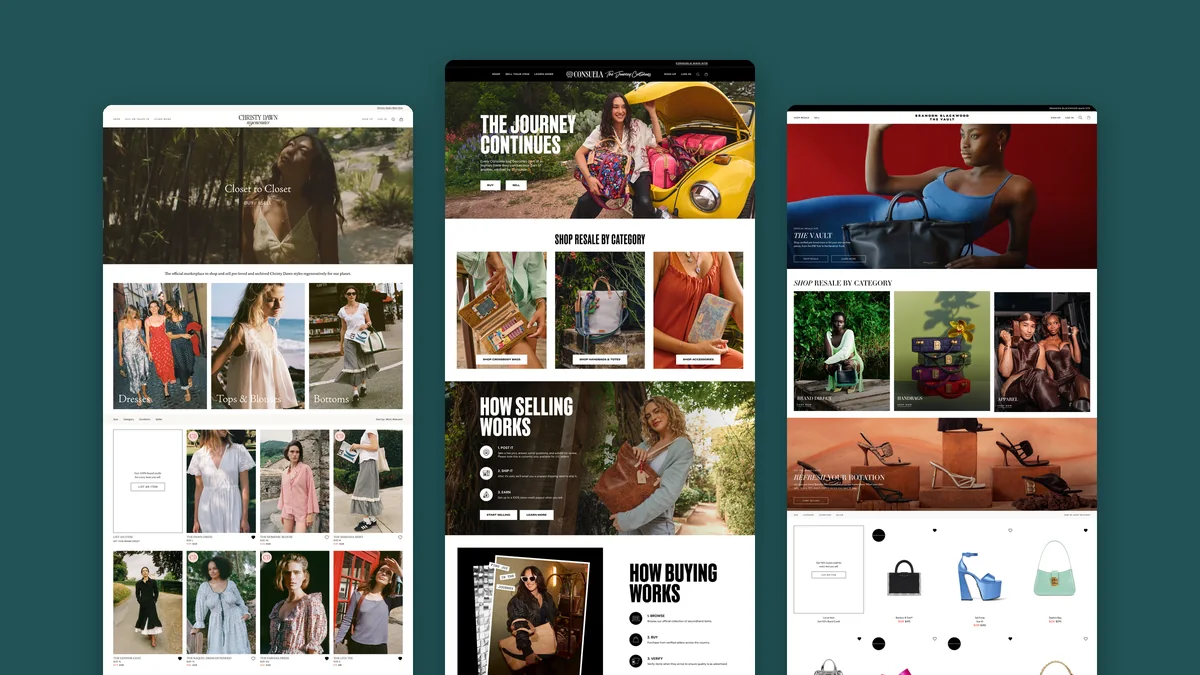
Turning fashion brand identities into production-ready resale sites.
Details
- RoleContract designer
- TimelineNov. 2025 - Aug. 2026
- SoftwareFigma, Rive
- TeamSales, brand experience, engineering
Overview
[1]What if your old favorites paid for new ones?
Treet helps fashion brands reclaim their resale markets. Each brand gets its own official resale site, where customers buy and sell the brand’s pre-loved pieces, and sellers can get paid in brand credit to spend on the main site.
I joined Treet as a contract designer in November 2025. I worked directly with fashion brands to design a mockup of their resale marketplace in Figma, taking in each brand’s branding, style and fonts while fitting it into what Treet’s website builder is capable of. Along the way, I worked closely with Treet’s sales and engineering teams, and later I took on motion design for Treet’s own website too.
Designing for the builder
[2]Making every brand feel like itself
Every Treet site is put together from the same set of components in Treet’s site builder. A few are required on every site: the navbar, the hero and the subscribe form. The rest, like image and text blocks, multi-item rows and info blocks, can be customized to fit the brand. Treet’s framework has been tested across more than 300 site launches, so my job was to make each brand feel like itself inside it, without designing anything the site build team couldn’t ship.
Each mock file also ended with a component library, so brands could see what else they could choose from.
Two templates to choose from
Brands picked one of two templates: Option A, a dedicated landing page built from components, or Option B, a shop-forward page that goes straight from the hero into the listings. On Option B, only general assets like images, logos and colors can be swapped.
Mobile
Every mock came with mobile versions too, since the images a brand uploads have to look good in a phone’s aspect ratio as well.
Handing it off
Each mock went to the brand with a page of instructions: how to open the prototype, pick a template and leave comments right in Figma.
To keep each launch on schedule, brands got one round of feedback and revisions, with edits due within 3 business days. That made the first mock count.
Fast turnarounds
[3]Need a mock by tomorrow?
Brands often asked me to turn around a mock or make edits as soon as possible, sometimes within a single business day. A mock needs a wide variety of assets to get the full feel of a brand. Every brand has specific icons they want, like for the search bar and shopping cart, and the fonts are a big part of their branding, so they have to be exact.
A lot of the time, brands didn’t send me these assets, and there was no time to wait for them. So I made my own in Figma from scratch, using the pen and shape tools to draw SVGs that match the brand’s icons as closely as possible. The wishlist (or like) button is a big part of a Treet resale site, but most brands don’t have one on their main site, so I’d draw a heart that matches the rest of their icons. For fonts, I pulled them straight from the brand’s main website with inspect element.
Because of this, I could deliver on quick turnaround requests even in a time crunch. It often surprised brands in a good way, moved their onboarding at Treet along a lot faster and helped make sure they didn’t drop out of the process.
When a brand pushed back
[4]Back to the Figma drawing board
Usually, brands were very happy with the first mock I presented. But once, a brand didn’t like my work at all and asked for something more inspiring. What made it harder was that they came into the partnership with high expectations, and I felt that if I didn’t get it right, Treet could lose a good brand deal. So I went back to the Figma drawing board completely, to meet their request while staying within the engineering limits of the site build team.
I asked them for more direct feedback on my work and learned that they wanted a higher-end, luxury, premium feel. With that in mind, I showed them resale sites I had designed for other upscale fashion brands, to get a feel for what they liked. We talked through the parts of those sites they resonated with, and I iterated my design from there.
The brand stayed with Treet and moved on to the next stages of onboarding, so Treet didn’t lose the deal. For future brands, I suggested that Treet’s brand experience reps (the people who go out and find brands Treet could work with) share examples of my past work up front, so brands know beforehand what Treet can realistically build.
Live sites
[5]From Figma mock to live site
Treet’s engineering team built each resale site from my Figma mock. Here are two of them next to the live sites.
And a few more of the sites, as they look today:
All 14 live sites
Motion for treet.co
[6]Why should a landing page stand still?
I was hired to design resale site mocks and work with the sales and engineering teams. But I was really interested in Treet as a company. I’d never heard of anyone helping brands reclaim their resale markets before, so I wondered if they had any competitors. They did, and when I looked at their websites, I noticed they all had kind of boring landing pages: a static hero section with a picture, text and buttons. I thought I could help Treet stand out in a small way with a motion design asset for its landing page, something that’s always moving and gives prospective brands a little extra wow factor.
I brought it up to my supervisor at the time, who really liked the idea, and Treet’s founder gave me the go-ahead to try it. I started with the static design in Figma, along with a storyboard of how the motion would play out. After approval, I built it in Rive, a platform for interactive designs and animations on the web, so it could be easily implemented in Treet’s frontend code. I also went out of my way to spruce up their buttons and tiles with hover states, which I designed in Rive too.
My work went live on Treet’s website and is still front and center in the hero today. Motion design was added to my contract, along with a small pay increase. I’m really glad my initiative paid off for both me and the company!
Launch kits
[7]Getting the word out
A new resale site also needs customers who know about it, so I designed launch templates that brands fill in with their own name and logo: emails for Klaviyo, at the 600px width it recommends, and Instagram posts and stories that explain how buying and selling work.
Reflection
[8]What I learned
Treet taught me to design inside real constraints. Every site had to feel like the brand and still fit what the builder could do, and most of the time it had to be ready fast. When a brand wasn’t happy, asking for direct feedback and showing real examples got us much further than guessing.
Initiative pays off
Pitching one animation for the landing page turned into motion design becoming part of my role, which is the kind of work I do now as a UX motion design intern at Amazon.